

Managing social impacts
The Borumba Pumped Hydro Project is expected to deliver value for local and regional communities.
Social and economic benefits from the exploratory works for the Project may include:
- improvements to roads
- patronage of local businesses
- opportunities for Kabi Kabi businesses, alongside opportunities for local businesses and the wider local workforce
- provision of geological and environmental data to regulatory agencies
The exploratory works are critical activities that will confirm geotechnical conditions and characteristics of the Borumba Pumped Hydro Energy Storage Project site. These activities will inform the detailed design of the proposed Project. The works include surface geotechnical investigations, such as boreholes, geotechnical excavation works to reach the location of the proposed underground cavern, and a range of temporary supporting works.
As we progress towards the Main Works phase, there will be increasing opportunities for local and indigenous businesses, job creation, and regional development.
Social Assessment and the Social Assessment Management Plan
A Social Assessment (SA) and Social Assessment Management Plan (SAMP) for exploratory works have been agreed with the Office of the Co-ordinator General.
The documents are part of the Queensland Government’s requirements under the Borumba Pumped Hydro Energy Storage Project Exploratory Works – Geotechnical and Investigations Works Project Report for the Works Regulation made under the State Development and Public Works Organisation Act 1971 (Qld), and are subject to assessment by the Queensland Office of the Coordinator-General. The SAMP addresses key matters within the Coordinator-General’s Social Impact Assessment Guideline (DSDILGP, 2025).
- The SA identifies and assesses the social impacts that may occur in local and regional communities during exploratory works. The communities are within the Somerset Regional Council and Gympie Regional Council areas.
- The SAMP details the social impact mitigation and benefit enhancement measures (collectively referred to as “management measures”) required to manage significant potential social impacts identified. These management measures will be reported against and adaptive measures undertaken, as the project moves through exploratory works.
The SA and SAMP included consultation with affected stakeholders to understand impacts and develop management measures. The drafting of the documents also occurred in tandem with the development of the draft Preliminary Documentation, as part of the Commonwealth regulatory approval process for the exploratory works. Community submissions around traffic and social concerns submitted as part of the preliminary documentation were considered when developing the management measures.
Documents
- Borumba Pumped Hydro Project Exploratory Works Social Assessment (SA) (PDF)
- Borumba Pumped Hydro Project Community and Stakeholder Engagement Plan – Exploratory Works (CSEP) (PDF)
- Social Assessment Management Plan Borumba Pumped Hydro Project Exploratory Works (SAMP) (PDF)
Key social matters
A Social Assessment (SA) and Social Assessment Management Plan (SAMP) for exploratory works have been agreed with the Office of the Coordinator-General.
- community and stakeholder engagement
- workforce management
- housing and accommodation
- local business and industry procurement
- health and community well-being.
This section provides a summary of the commitments in the draft proposed SAMP against each of these matters.
Traffic impact and road use
Major infrastructure projects, like the Borumba Project, will increase local traffic during construction activities. These activities include equipment and material deliveries, removal of spoil, and workforce transport. Our priority is to ensure that we can undertake these activities as safely as possible – for our people, and for the community.
The approved exploratory works traffic routes include two access routes – one to the upper site and one to the lower site;
Northern Route – provides access to the Main Site (Borgan) from Yabba Creek Road and Bella Creek Road via a network of connecting routes linking with the Bruce Highway and surrounding towns, such as Gympie and Imbil.
Southern Route – provides access via Kilcoy to the Upper Site (Walkers Top) via Kilcoy Murgon Road, Sunday Creek Road and Yielo Road.
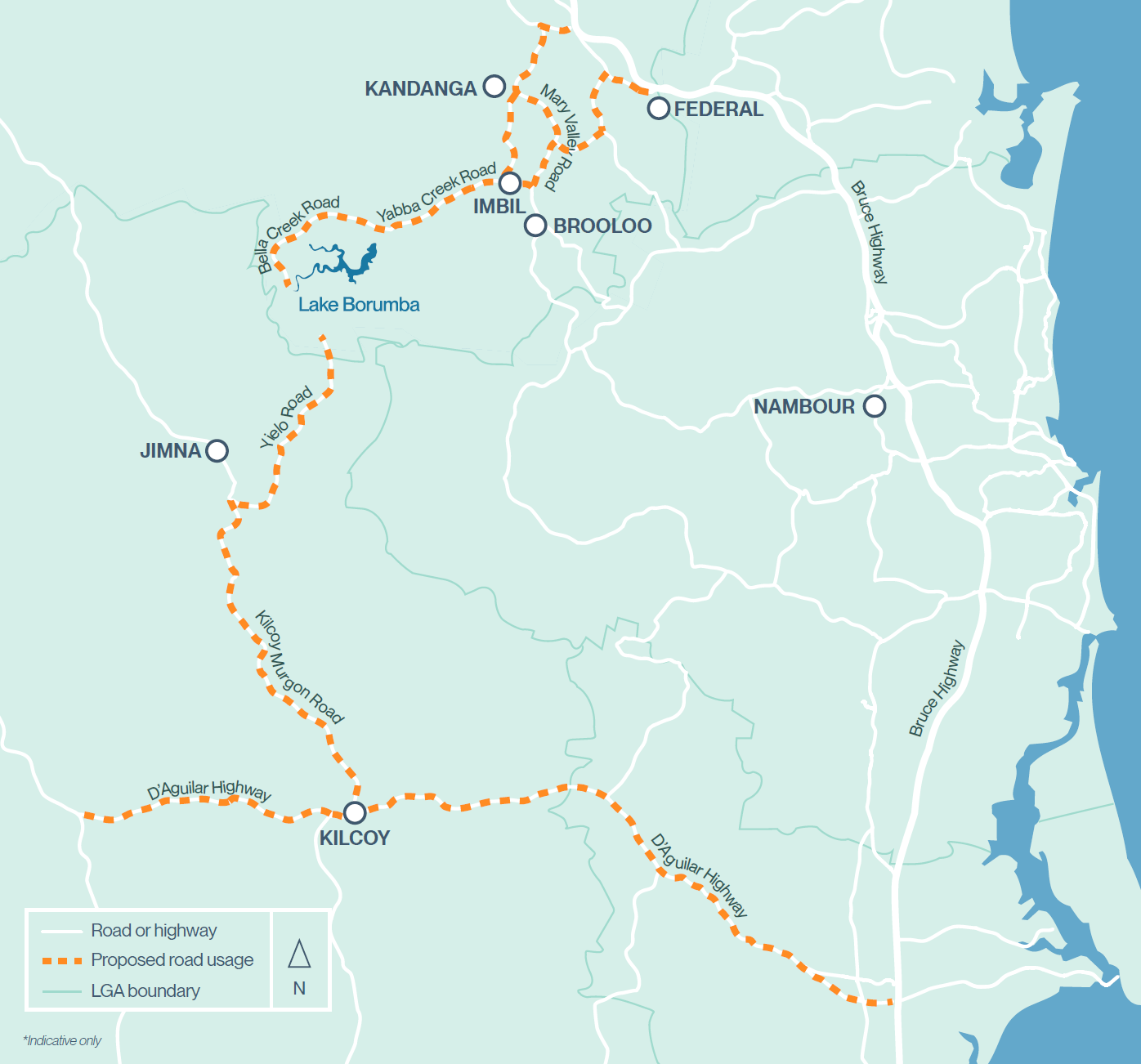
Minimising traffic impacts
Queensland Hydro is committed to minimising impacts on the communities around our proposed Borumba Project. We’ve developed a Road-use Management Plan (RMP) which sets out the measures we’ll take to keep motorists, pedestrians, and cyclists safe.
Key initiatives we’ll adopt include:
- reducing vehicle numbers travelling to site by providing park and or staging areas for the workforce
- limiting heavy vehicle use to selected routes
- restricting heavy vehicle movements on school bus routes and in the vicinity or school during drop off and pick up peaks
- promoting safe driving practices for employees and delivery partners
- undertaking improvements to the network where required
- managing traffic at identified pinch points on the network
- consultation with the relevant road authorities and or road managers on identified issues and
- mitigation measures
- proactive engagement with stakeholders to provide updates and receive feedback on anticipated
- traffic movements and management measures
- continuous evaluation of the effectiveness of mitigation measures and adjusting when required managing traffic at identified pinch points on the network
We will continue and adapt our traffic management measures based on community feedback and needs of the Project.
You can access the full documents here:
Queensland Hydro has developed a Community and Stakeholder Engagement Plan (CSEP) for the exploratory works phase. This plan supports Queensland Hydro’s management measures and adopts principles that ensure project information is accessible through different methods and formats, and that engagement activities are tailored to reach diverse audiences including vulnerable groups.
The CSEP will be published on Queensland Hydro’s website following the Office of the Coordinator-General’s acceptance of the plan (being assessed in conjunction with the Social Assessment and SAMP). Engagement plans reflect internationally recognised standards, such as consultation and engagement planned and delivered taking into consideration the IAP2 Public Participation Spectrum.
The Borumba Project Stakeholder Reference Group (SRG) is a consultative group which aims to capture stakeholder feedback about the Project, facilitating transparent, two-way community and stakeholder engagement. It is a core part of Queensland Hydro’s engagement with community, ensuring that stakeholder input informs the Project’s planning, design, construction, and operations. SRG meetings provide a forum for discussions about wide ranging project topics such as environmental assessments, Project design, potential impacts, community benefits, and more.
While the SRG covers a broad range of topics and updates, focus groups are designed to capture community and stakeholder feedback through facilitated in-depth discussions on dedicated topics. Currently Queensland Hydro has an Imbil and Surrounds Focus Group, Environment Focus Group and is in the process of establishing a Kilcoy, Jimna and Surrounds Focus Group.
Examples of engagement and communication methods for exploratory works includes:
- regular meetings of the Stakeholder Reference Group, focus groups and Environment Working Group
- Community Connect information sessions
- advance notification of exploratory works activities
- engagement with Somerset Regional Council, Gympie Council, state agencies, government departments and emergency services and health, education and training providers regarding impacts, management measures, and mitigations
- working with accommodation suppliers and business groups in the project area and surrounding communities to develop management measures to minimise the impact on the community and tourism industry
- building relationships with local businesses and suppliers
- engagement with the Kabi Kabi peoples and Butchulla peoples
- developing relationship management plans where required for specific stakeholders to address concerns associated with exploratory works
- developing, where required, property specific management plans to work with construction and manage risk
- ensuring stakeholder enquiries and complaints are addressed promptly and resolved appropriately
- quarterly reporting to monitor SAMP implementation and effectiveness.
Queensland Hydro will prioritise local workforce where appropriate. Queensland Hydro will implement a workforce development and local industry participation framework which will set guidelines including evaluating each procurement package using a range of standardised criteria that includes a focus on the contracted workforce’s capabilities, composition, local content, and diversity.
Examples of workforce management measures include:
- stipulating local employment targets, including diversity targets in procurement
- local advertising of employment opportunities
- manage workforce health and safety by developing Health and Safety Contractor Specification for Contractors
- provide advance notice to emergency and health service providers in the Project Area on exploratory works staging/timeframes
- participation in the local disaster management groups in the Project Area
- provision of onsite medical and paramedic services and a site emergency response team to reduce reliance on local social infrastructure and emergency services where possible
- implementation of the Workforce Code – Living and Working on the Borumba Project, outlining the standard of behaviour expected of all staff and contractors associated with the Borumba Project.
The Social Assessment considered townships adjacent to the Project, including Imbil, Kandanga, Brooloo, Amamoor and Dagun, which fall within the 4570 postcode (Gympie and surrounds). This data (SQM, 2024) was used to identify housing and accommodation statistics and inform the management measures outlined in the SAMP.
Stakeholder engagement for the SAMP, together with results of Queensland Hydro’s engagement for the exploratory works, highlighted concerns regarding increased pressure on low-income households, essential workers and other workforce sectors, rental capacity and affordability, and short-term accommodation options. To manage this, Queensland Hydro has dedicated onsite workforce accommodation, which will house the onsite Project workforce.
Queensland Hydro is committed to ‘buy local’ to provide local businesses with access to global supply chains via contractors, the government market and to stimulate regional economies.
The Australian Jobs Act 2013 (Cth) requires that proponents of major projects ($500 million and above) in Australia to develop and implement an Australian Industry Participation (AIP) plan. Under this plan, Queensland Hydro welcomes local business involvement.
Examples of the measures Queensland Hydro will introduce to promote to local business includes:
- Queensland Hydro website
- Queensland Hydro-led supplier briefings
- Queensland Government Supplier Portal
- Social Media
- ICN Gateway.
Queensland Hydro will maximise supply opportunities for First Nations owned and/or managed businesses, and where appropriate this means preferentially Kabi Kabi associated businesses, underpinned by a First Nations Participation Policy.
The exploratory works will generate both positive and negative impacts relating to health and community wellbeing. Works are anticipated to result in some pronounced traffic and amenity impacts during peak works periods while positive effects on health and wellbeing are expected to be generated through increased community benefits and investment opportunities.
Health and community wellbeing management measures for Exploratory Works include:
- Traffic Impact Assessment (TIA) and local traffic management plans
- Road Use Management Plan (RMP), including workforce commute considerations
- Queensland Hydro driver education campaign
- Construction Environmental Management Plan (CEMP) and supporting environmental management plans
- community wellbeing and cohesion initiatives
- promotion of community complaints, enquiries and feedback policy
- delivery of the Community Benefits Fund, incorporating grants, sponsorships, partnerships and community development initiatives
- Monitoring and reporting.
Implementation and monitoring of the SAMP will involve feedback from stakeholders and local councils. Adaptive measures will be used to adjust as necessary.
A report will be prepared and published by Queensland Hydro, based on the monitoring framework and agreed with the Office of the Coordinator-General.